Can You Appraise Jewelry Without a Receipt?

Can You Appraise Jewelry Without a Receipt?

Short answer: Yes — absolutely. A jewelry appraisal does not require a receipt, original box, or purchase documentation of any kind. Whether you inherited a diamond ring from your grandmother, purchased a vintage brooch at a flea market, or simply misplaced your paperwork years ago, a certified appraiser at a professional jewelry appraisal service can still determine the value of your piece with accuracy and confidence.

At Solomon Gold, we perform appraisals every day on pieces with zero paper trail. Our certified appraisers rely on the physical characteristics of the jewelry itself — not on what you paid for it or where you bought it.
In this guide, we’ll cover everything you need to know: how jewelry appraisals work without receipts, who benefits most, a real-world example, and answers to your most common questions.

What Is a Jewelry Appraisal?

Think of a jewelry appraisal like getting a report card for your jewelry. A trained expert examines your piece closely and writes down exactly what it’s worth — based on what it’s made of, how it’s made, and the current market.
A receipt tells you what someone paid for a piece of jewelry at a specific moment in the past. An appraisal tells you what that piece is worth right now, in today’s market.

Simple version: A receipt is your history. An appraisal is your present-day truth.

Jewelry changes in value over time. A diamond ring bought in 1995 for $2,000 might be worth $8,000 today — or more. The only way to know for certain is through a current jewelry appraisal from a certified professional.
And here’s the key point: appraisers don’t appraise receipts. They appraise jewelry. The physical item is all they need.

How Do Appraisers Value Jewelry Without a Receipt?

jewelry appraisal near me Professional appraisers at a jewelry appraisal shop use a systematic, evidence-based process to determine value. Here is exactly what they examine:

1. Metal Identification & Purity

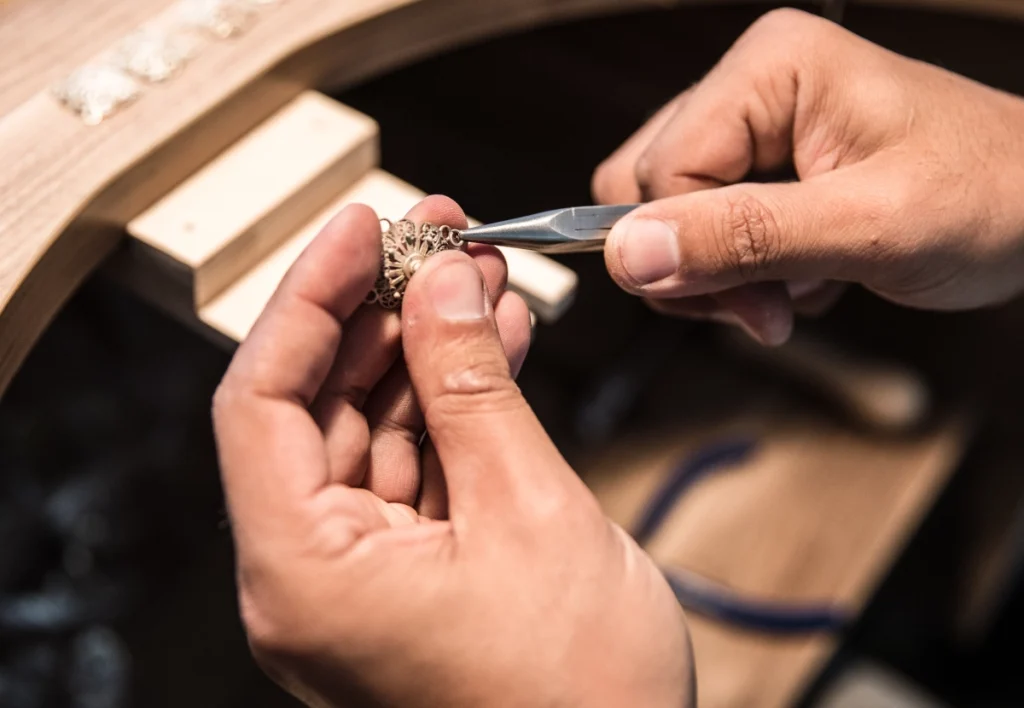
Appraisers use acid testing, electronic testers, and X-ray fluorescence (XRF) analysis to determine the exact composition of the metal — whether it’s 18K gold, 14K gold, sterling silver, platinum, or another alloy. They also assess its weight and current melt value.

2. Gemstone Analysis

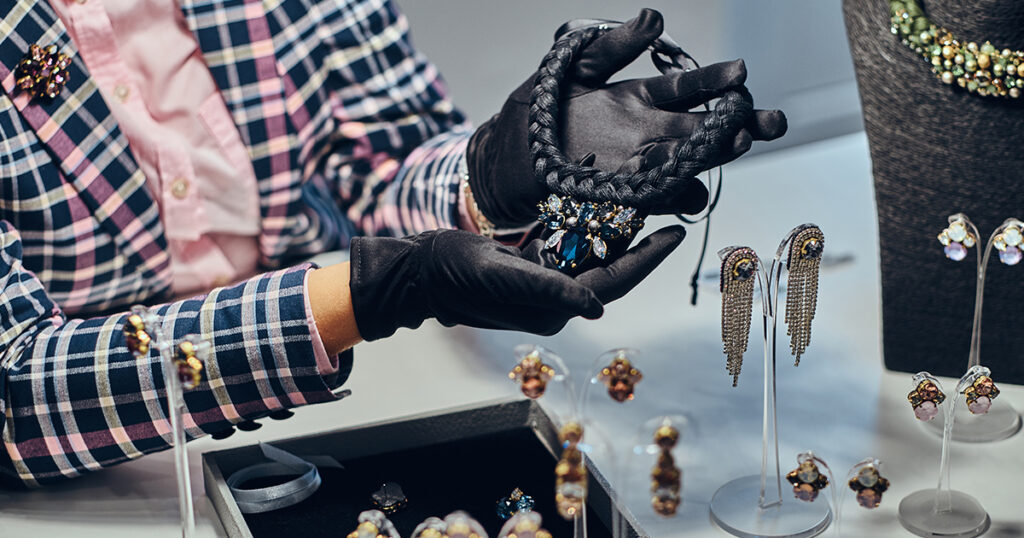
Using professional-grade loupes (10x magnification), microscopes, and gemological instruments, appraisers evaluate all gemstones using the internationally accepted 4Cs:
  • Cut — the quality and style of the stone’s facets
  • Color — graded on a scale (D-Z for diamonds, with D being colorless)
  • Clarity — the presence or absence of inclusions and blemishes
  • Carat Weight — the precise weight of the stone
For colored gemstones, additional factors like origin, treatment history, and rarity are also considered.

3. Craftsmanship & Design Period

Skilled appraisers — especially those specializing in antique jewelry appraisal — can identify the era and style of a piece through its construction techniques, hallmarks, and design motifs. Victorian, Art Deco, Edwardian, and Mid-Century Modern pieces each carry distinct signatures that affect value significantly.

4. Hallmarks & Maker's Marks

Most jewelry is stamped with hallmarks — tiny symbols or numbers that indicate metal purity, country of origin, and sometimes the maker. Appraisers reference comprehensive databases of hallmarks worldwide to authenticate and date your piece.

5. Current Market Comparables

Appraisers research recent sales data from auctions, retail markets, and estate sales to determine what comparable pieces are selling for today. This market intelligence is what transforms physical analysis into a reliable value conclusion.

Who Needs a Jewelry Appraisal Without a Receipt?

Insurance Coverage Seekers

If you own valuable jewelry — whether purchased, gifted, or inherited — you need a current appraisal to properly insure it. Most homeowner’s and renter’s insurance policies cap jewelry coverage at $1,000–$2,500. A standalone jewelry rider or specialist policy requires a written appraisal.
The critical question insurers ask: What is it worth right now?
They don’t ask: What did you pay for it ten years ago?
Solomon Gold tip for insurance seekers: Get your appraisal updated every 2–3 years. Gold and diamond prices fluctuate, and an outdated appraisal could leave you underinsured after a loss.

Lost your receipt before getting your ring insured? No problem. Our jewelry appraisal service provides insurance-ready documentation regardless of your paper trail

Estate Settlers & Heirs

When a loved one passes away, jewelry often becomes one of the most emotionally charged — and undervalued — assets in an estate. Whether you’re an executor dividing assets fairly among heirs, a beneficiary trying to understand what you’ve inherited, or an estate attorney or accountant preparing tax filings, you need accurate, defensible valuations.
Receipts from decades ago — even if available — are legally inadequate for estate purposes. Courts, the IRS, and state tax authorities require current fair market value assessments performed by qualified appraisers.

Solomon Gold tip for estate heirs

We provide estate-specific appraisal reports that meet IRS requirements for Form 706 (Estate Tax Return) and state probate proceedings.

Resale & Auction Sellers

Thinking about selling a piece of jewelry? A professional appraisal gives you the power to negotiate from a position of knowledge. Without one, you’re guessing — and dealers know it.
Auction houses including Christie’s, Sotheby’s, and Heritage Auctions strongly recommend or require appraisals for jewelry over certain value thresholds. Estate sales, consignment shops, and online resale platforms also benefit from certified documentation.
A jewelry appraisal near me is an investment, not an expense — when you know your piece’s true value, you won’t accept a lowball offer or leave money on the table.

One Solomon Gold client discovered a 'costume brooch' from her aunt's estate was actually a signed Cartier piece worth $14,000. An appraisal changed everything.

Real-World Example: The Inherited Sapphire Ring

Meet Patricia. When her mother passed away, Patricia inherited a sapphire-and-diamond ring she’d seen on her mother’s finger her entire life. There was no receipt, no insurance document, no paperwork of any kind. Patricia didn’t even know if the stones were real.
She came to Solomon Gold for a jewelry appraisal — nervous that without documentation, we wouldn’t be able to help her.

Here’s what our appraiser found in the next 45 minutes:

  1. The ring was set in 18K white gold (confirmed via XRF testing)
  2. The center stone was a natural, untreated Ceylon (Sri Lankan) blue sapphire — 3.2 carats — one of the most sought-after origins for sapphires
  3. It was flanked by 14 round brilliant diamonds totaling 0.84 carats (VS1 clarity, F-G color)
  4. The setting style dated the piece to approximately 1940–1955 (Late Art Deco / Retro period)
  5. Hallmarks confirmed a French maker

Patricia’s result: A certified appraisal valuing the ring at $22,500 for insurance purposes — and a market value estimate of $14,000–$18,000 for potential resale.

No receipt. No box. No problem.

Types of Jewelry Appraisals — Which Do You Need?

Appraisal Type

Best For

Value Basis

Insurance Replacement Value

Homeowners, jewelry riders

Retail replacement cost

Fair Market Value

Estate/probate, IRS, donations

What a buyer would pay today

Liquidation Value

Quick resale, divorce proceedings

Price in urgent sale

Antique Jewelry Appraisal

Vintage & period pieces

Age, rarity, collector demand

Online Jewelry Appraisal

Remote/convenience clients

Based on photos & documentation

Frequently Asked Questions

Can I get a jewelry appraisal without a receipt?
Yes, completely. Professional appraisers evaluate the physical piece — its metal, gemstones, craftsmanship, and condition — not your paperwork. A receipt is irrelevant to the appraisal process.
Bring the jewelry itself. Any supporting documentation (old appraisals, certificates like GIA reports, photos, family history) can be helpful but is never required.
Appraisal fees typically range from $50–$150 per piece at most jewelry appraisal shops, with some charging hourly rates of $75–$200/hour. Never use an appraiser who charges based on a percentage of the appraised value — this creates a conflict of interest.Yes. Professional repair shops like Solomon Gold provide fair pricing while maintaining high-quality workmanship.
A standard jewelry appraisal usually takes 30–60 minutes in person. Complex pieces — especially antique jewelry appraisal cases — may require 1–3 business days for research and documentation.
An online jewelry appraisal can provide a reliable preliminary estimate based on high-quality photographs and measurements. However, for insurance, estate, or legal purposes, an in-person appraisal by a certified professional is strongly recommended and sometimes required.
Every 2–3 years, or after any significant change in gold, platinum, or diamond prices. Your jewelry appraisal near me should be current enough to reflect today’s replacement cost — not the market from five years ago.
Yes. Skilled antique jewelry appraisers identify period, origin, and maker through physical evidence — hallmarks, construction techniques, and design characteristics — without any provenance documentation.
A fair market value appraisal will give you a realistic selling price range. This differs from an insurance replacement value, which is typically 20–50% higher. Ask your appraiser to specify which type of value they’re providing.
Look for certifications from recognized bodies such as the Gemological Institute of America (GIA), the American Society of Jewelry Appraisers (ASJA), or the International Society of Appraisers (ISA). At Solomon Gold, all our appraisers hold recognized credentials.
The terms are often used interchangeably. Technically, an appraisal is a formal written document prepared by a certified professional, while a valuation can be an informal estimate. For insurance, estate, and legal purposes, always request a formal jewelry appraisal.

Ready to Discover What Your Jewelry Is Really Worth?

No Receipt? No Problem. No Guessing. Just Answers.

Your jewelry tells its own story. Let Solomon Gold read it. Whether you need an appraisal for insurance, estate settlement, or resale — our certified experts are ready.

About Solomon Gold

Solomon Gold is a trusted jewelry appraisal service with certified experts specializing in diamonds, colored gemstones, antique jewelry appraisal, estate pieces, and modern fine jewelry. We provide detailed, legally defensible appraisal reports for insurance, estate, resale, and personal purposes.
Scroll to Top